
Levels for AI Standards
A shared framework for understanding and disclosing the use of AI in creative work.
This website and its AI Usage Scale are intended to support clear, productive conversations about the use of AI in writing. The scale does not prescribe ethical standards; those decisions remain with individual writers, editors, publishers, educators, and organizations.
You are welcome to use the scale to describe how extensively AI was used in a piece of writing or to establish how much AI involvement you will accept in submitted work. Please cite this website when referencing or reproducing the scale.
CONTRIBUTE:
The AI Usage Scale is an evolving framework designed to encourage clear communication about AI use in writing. We welcome constructive feedback as the project develops. Please use the form to the right to contact us with your comments, questions, or suggestions.

AI Usage Scale for Writers (1–10)
A 10-point scale to help the writing community assess and disclose the level of AI involvement in their work.
| LEVEL | Guidelines | |
| 1 | Proofreading and Research | Author writes text. AI corrects spelling, punctuation, capitalization, formatting, and obvious typos. No wording, structure, or creative content changes. The text remains exactly the author's work. AI assists in researching setting, language, historical context. |
| 2 | Copy Editing | Author writes text. AI identifies grammar issues, word repetition, awkward phrasing, readability problems, and consistency errors. The author makes all revisions manually. AI functions like a copy editor. |
| 3 | Critique Partner | Author writes text. AI analyzes pacing, character motivation, plot holes, clarity, scene structure, emotional impact, market fit, or reader confusion. AI provides feedback only. The author writes all solutions. |
| 4 | Brainstorming Assistant | AI helps generate ideas, titles, names, settings, plot possibilities, character backgrounds, themes, and alternative approaches. None of the generated text appears in the final manuscript without significant author transformation. |
| 5 | Developmental Collaborator | AI suggests scene concepts, outlines, chapter structures, character arcs, and story solutions. The author remains responsible for writing the actual prose. |
| 6 | Revision Assistant | AI proposes sentence-level improvements, alternate dialogue, stronger descriptions, transitions, or rewritten passages. The author selectively incorporates or modifies suggestions. Original authorship remains dominant, but AI language begins appearing directly in the manuscript. |
| 7 | Co-Drafting | AI writes portions of scenes, descriptions, dialogue, query letters, synopses, or chapters based on the author's instructions. The author heavily edits and curates the output, but AI is contributing original wording, not merely advice. |
| 8 | Co-Authoring | Significant portions of the manuscript are drafted by AI. The author directs the project, provides revisions, and shapes the final product, but AI contributes substantial amounts of finished prose. |
| 9 | AI-Dominant Creation | AI generates most of the manuscript. The author primarily acts as editor, curator, prompt designer, and decision-maker. |
| 10 | Full AI Generation | The work is substantially generated by AI with minimal human intervention beyond prompting andselection. The human functions more as publisher or producer than author. |
Summary
This scale focuses on who is making the creative decisions and generating the final prose. Levels
1–4 generally involve feedback and assistance. Levels 5–6 involve developmental and revision
support. Levels 7–10 involve increasing amounts of AI-generated text and authorship.
Grammarly and ProWritingAid tools range from level 1 to 7+, depending on which tools are used. This scale measures how the tool is used, not the software itself, which is often updated with new features.


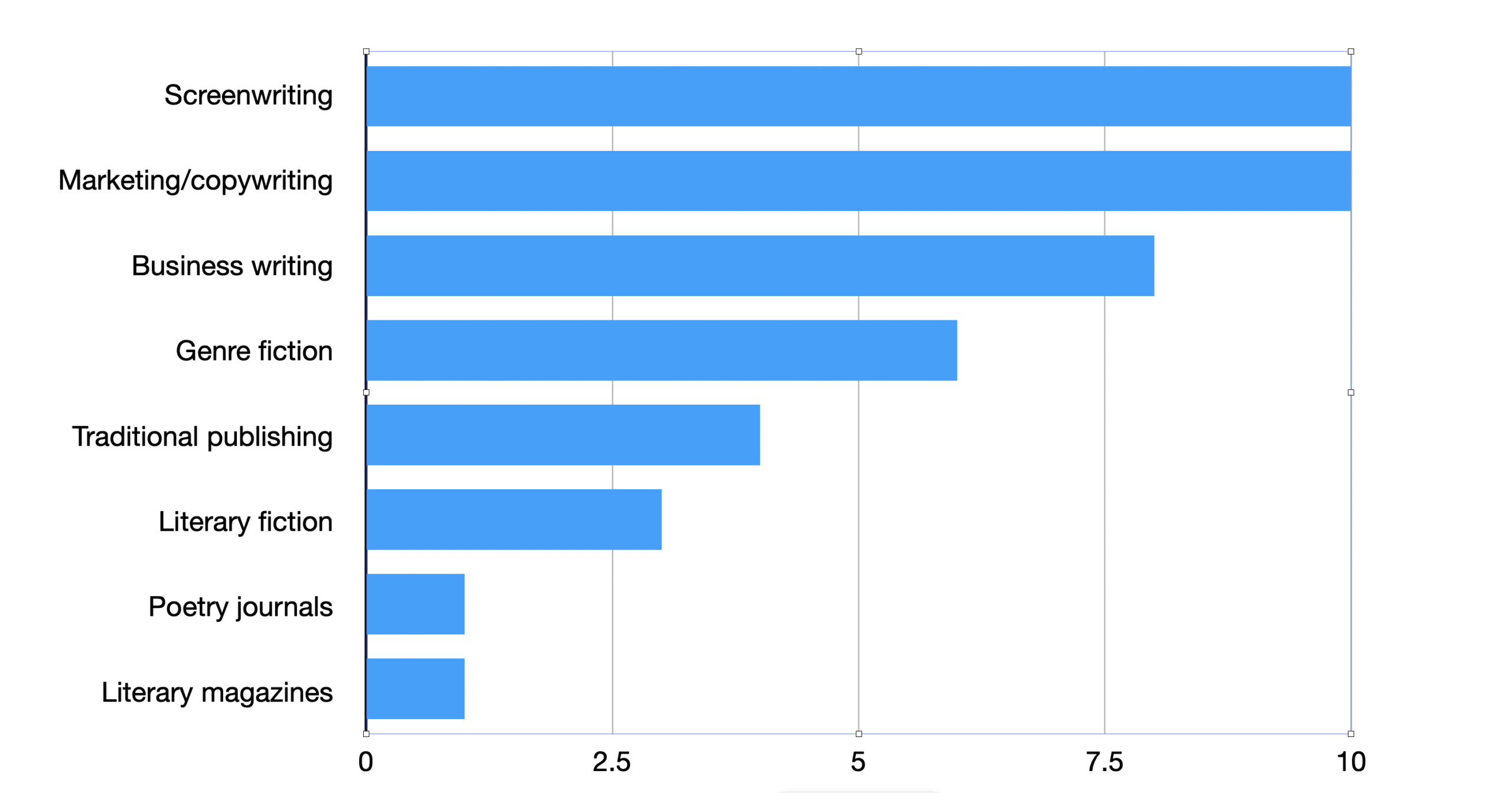
Relative acceptance of AI-assisted writing
Higher scores indicate greater industry tolerance for AI-assisted work, based on current publishing and entertainment trends rather than formal rules.
| Category | Current attitude |
| Screenwriting | Generally concerned with the final script, not the drafting process. |
| Marketing/copywriting | AI use is widespread. |
| Business writing | Commonly accepted. |
| Genre fiction | Mixed. Many publishers care more about quality than process. |
| Traditional publishing | Increasing scrutiny, varies by publisher. |
| Literary fiction | More resistant. |
| Poetry journals | Often highly resistant. |
| Literary magazines | Frequently require little or no AI involvement. |

RESOURCES
Guides, articles, policies and tools to help you create with integrity and clarity
Browse Resources: coming soon